How to Create Two Google Ads and Let 12 Buyers Pick the Winner
By Jon Roland · October 25, 2026
Most ad advice starts the same way. Write your ad, launch it, then watch the numbers for a week and hope. The problem with that order is that the first people judging your ad are the ones you are paying to reach. By the time you know whether it works, the money is already gone.
The video above walks through a different order. I had CouncilAds write two Google ads for my own business, then put them in front of the Council - 12 AI buyer personas, each built to react like a different kind of real customer - before a single click was paid for. Here is what happened, and how you can run the same thing yourself in a few minutes.
The two ads: one leads with the problem, one with the outcome
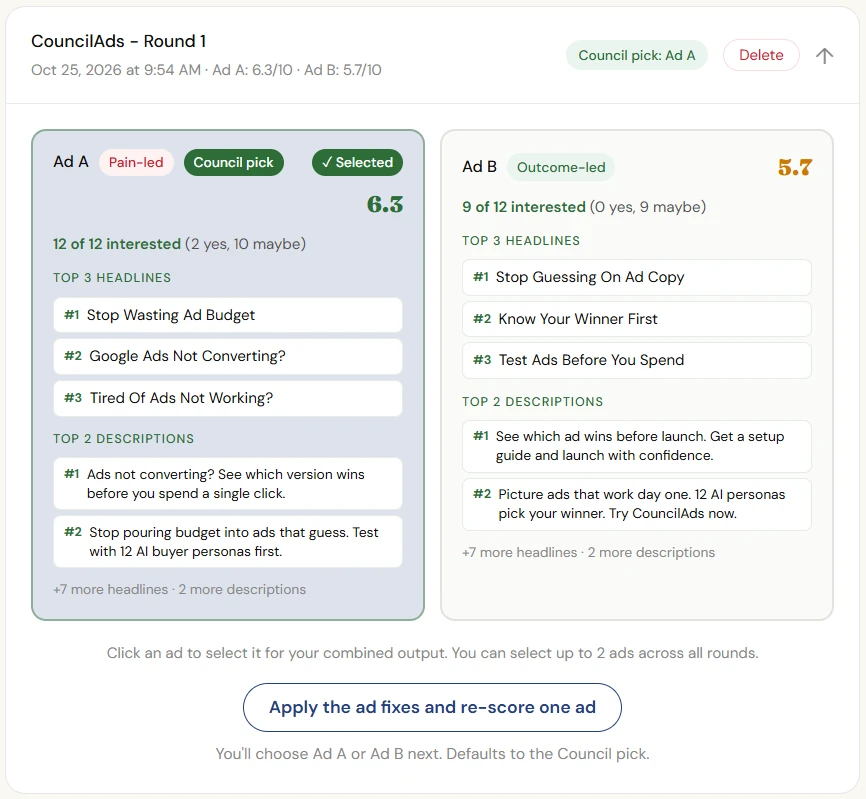
When you run CouncilAds it does not hand you one ad to take or leave. It writes two, on purpose. One leads with the customer's problem, the thing that made them search in the first place. The other leads with the outcome they want, the result on the other side. Same business, two honest angles, so you are comparing real options instead of staring at a blank box.
In the video, the two it wrote scored a 6.3 and a 5.7. The Council picked the 6.3 as the stronger of the two.
How the Council scores, and why a 6.3 is good
If a 6.3 sounds low, that is the point. The scores are tough on purpose. The Council rarely gives anything above a six. A strong ad lands in the high fives and low sixes, not eights and nines, and a perfect 10 is impossible by design.
So read the number the way the Council means it. A 5.7 is a decent ad. A 6.3 is a good one. If you have been grading your own ads on a curve where everything you write feels like an eight, this is the reset. The bar is honest, and a half-point gap between two ads is a real difference, not a rounding error.
The whole idea behind the 12 personas came from a Harvard study on using AI personas as artificial audiences. Instead of one imagined "ideal customer," you get the skeptic, the price shopper, the one who has been burned before, and the one who is ready to buy right now, all looking at the same ad and all seeing something different.
What the key findings said is still holding buyers back
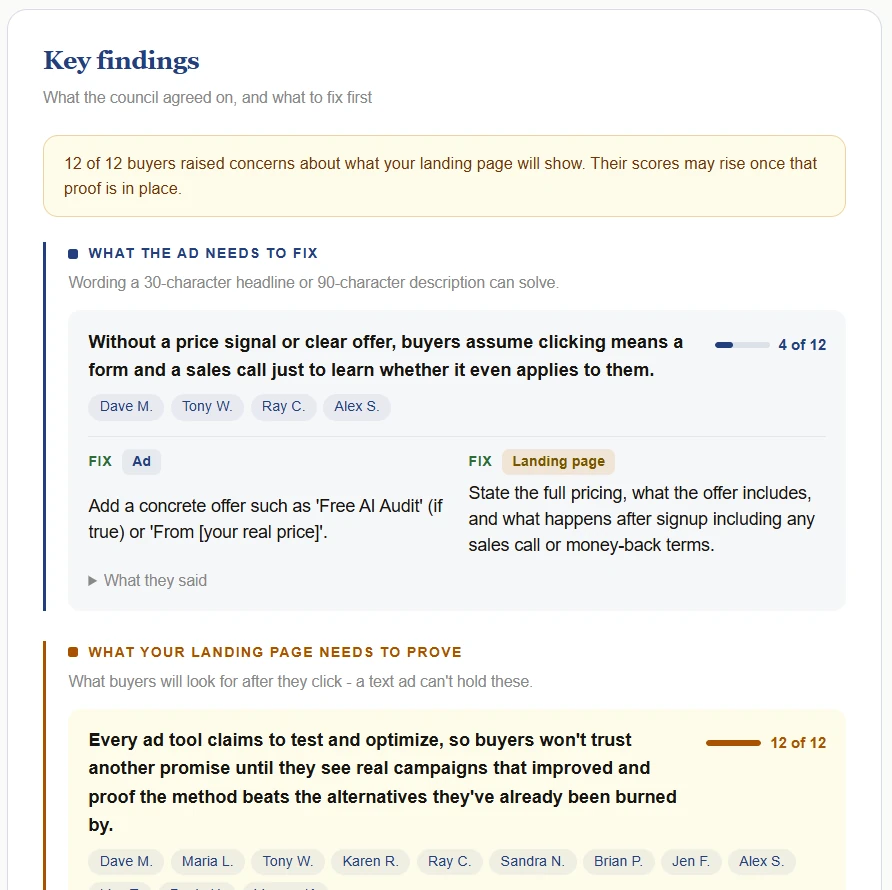
The scores tell you which ad is stronger. The key findings tell you why buyers hesitate on either one, and this is the part worth reading twice.
The headline finding on my run: 12 of 12 buyers raised concerns about what my landing page would show. Every single persona. Their scores could rise once that proof is in place, which means the ad was not the weak link. The page it points to was the open question.
The reason is plain, and it is probably true of your page too. Without a price signal or a clear offer, buyers assume that clicking means a form and a sales call just to find out whether the thing even applies to them. That is a big ask for a stranger, and plenty of them will not make it.
The findings named the trust problem head on as well. Every ad tool claims to test and optimize, so buyers will not trust another promise until they see real campaigns that improved and proof the method beats the alternatives they have already been burned by. Examples, testimonials, a real before and after. That is landing-page work, and the Council flags it before you have spent a dollar learning it the expensive way.
How to run your own two ads
Here is the whole loop from the video, start to finish.
Paste your website and hit enter. CouncilAds reads your site and fills in the context it needs to write two good ads, so you are not typing out a long form. That form is exactly the kind of friction that makes people quit before they start.
Check the free-offer box. There is a checkbox for whether the ad has a free offer. In the video I was not offering anything free, so I left it unchecked, and CouncilAds keeps "free" out of your search as a negative keyword on its own. That stops the ad from pulling in people hunting for something free and burning the clicks. If you do have a free offer, you check the box and it leaves that negative off so those searchers can find you. Small setting, real money.
Hit run. Both ads go in front of the Council of 12, and you get back two scores, the winner, the key findings, and the full ad text ready to paste into Google Ads.
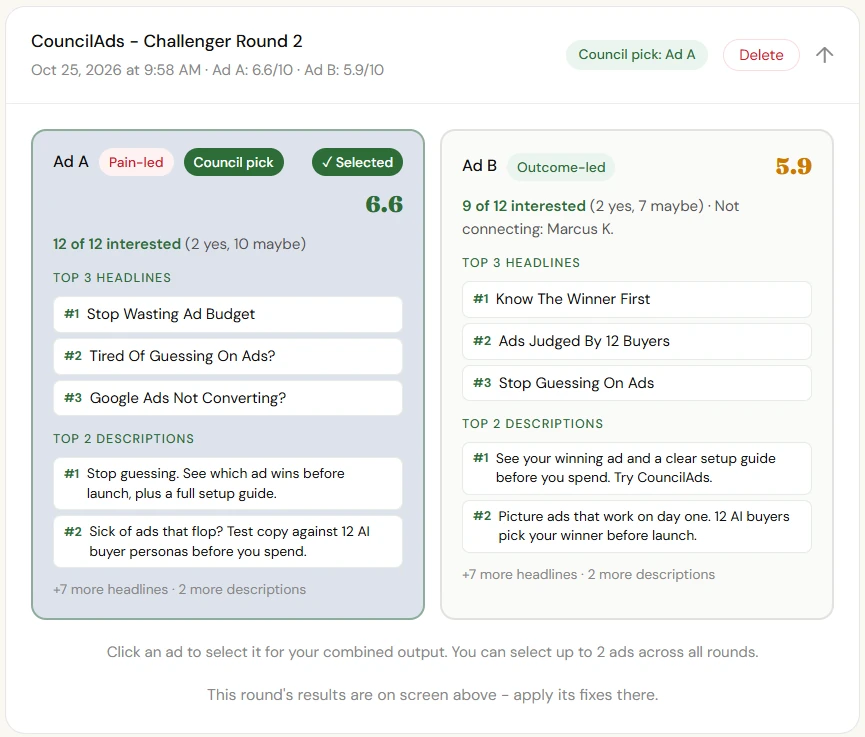
Not happy with the two? Run a challenger round. In the video the challenger ads came back at 6.6 and 5.9 and beat both originals by a little. That left four ads to choose from, and I picked the 6.6 and the 6.3 to move forward with.
Send it to whoever runs the ads. You can email the combined report to your PPC person or to anyone on your team. It comes with a campaign setup guide: the keywords to bid on, the negatives to set, and the reports to watch. If someone can follow a recipe, they can follow this and get the ads live.
The order is the whole trick
Write two ads, let 12 buyers argue over them, fix what they flag, and only then spend. You end up launching the ad that already survived the skeptic and the price shopper, instead of finding out what they thought after the budget is gone. That is the core idea behind the Ad Tester.
One honest note from my own run. Every persona pointed past the ad to the landing page. The ad can do its job perfectly and still lose the sale if the page does not continue the conversation the ad started. That is its own review, and it is coming in another video.
If you want more plain-English breakdowns like this, you can add CouncilAds as a Google Preferred Source - https://google.com/preferences/source?q=councilads.com - so these show up when you are searching for real answers about your ads.
You can run your first ads past the Council without paying anything. 6 free runs, no credit card required. Write two ads and see what 12 buyers think before you spend a dollar: https://councilads.com/app?ref=blog-create-two-ads